
01
★★★★★
“It was my first visit, and the staff were incredibly friendly. The clinic was clean, and the treatment was carried out with care and attention. I was very satisfied with the experience.”
Angela Park
Google Review
G

An individualized approach to cystic acne focused on understanding deeper inflammatory lesions, evaluating the current skin condition and planning appropriate acne care for the face.
Cystic acne may appear as larger, deeper and often tender inflammatory lesions. Because the visible surface does not always show the full extent of the lesion, a focused assessment can help determine the appropriate direction of care.
At JRYN Dermatology Clinic Seomyeon, the approach begins with understanding the current skin condition and the pattern of active lesions. Treatment planning is then adjusted to the individual's skin rather than relying on a single approach.
Acne care centered on the depth, inflammation and condition of the skin.
Cystic acne refers to deeper inflammatory acne lesions that may appear larger, more swollen or more tender than typical surface-level breakouts. The location, frequency and appearance of these lesions can vary significantly from one person to another.
Treatment planning therefore starts with careful assessment rather than applying the same approach to every patient. The current condition of the skin, active lesion pattern, previous acne history and areas of concern can all be considered when creating an individualized treatment plan.
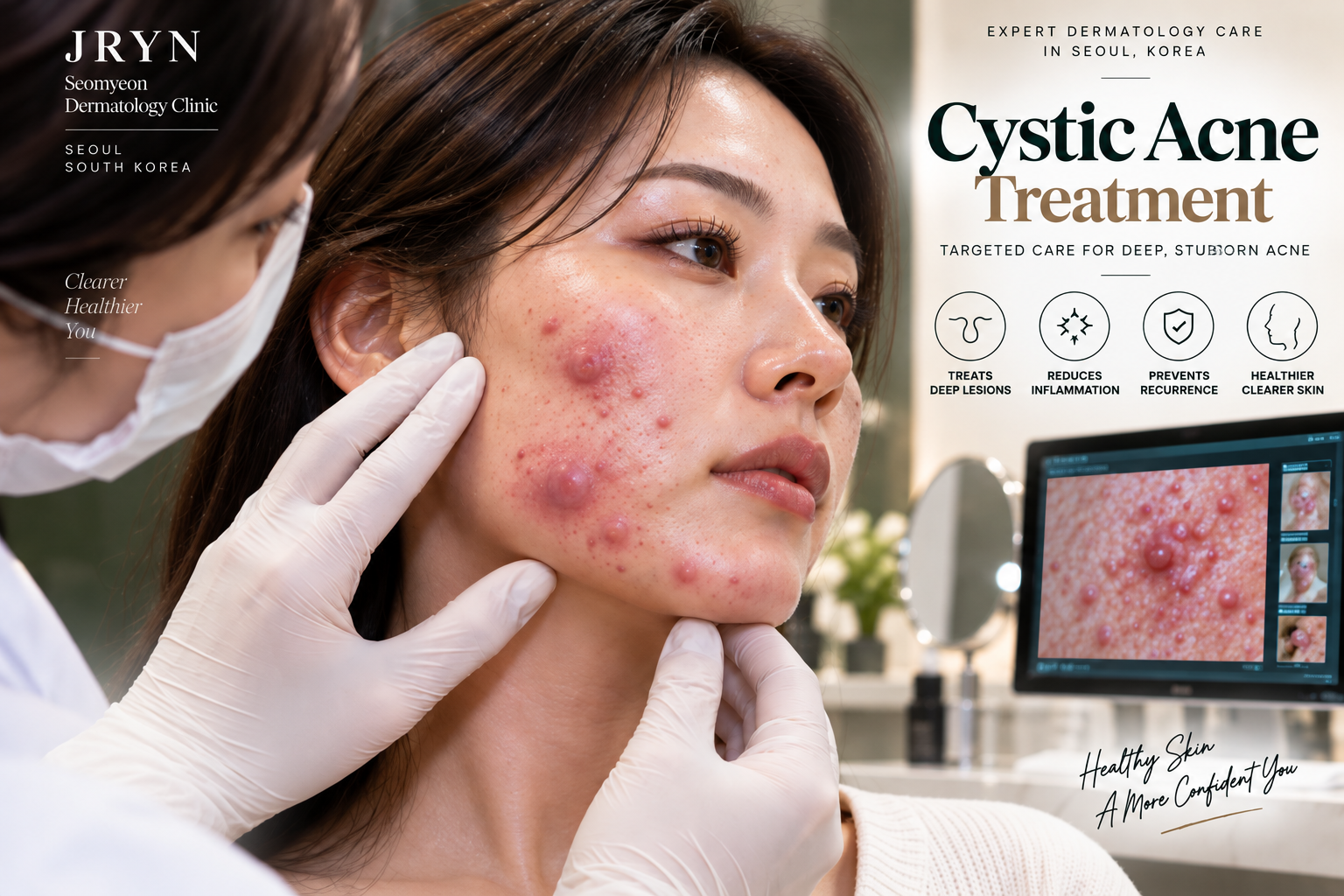
Cystic acne can present differently across the face and may coexist with redness, sensitivity, post-acne marks or uneven texture. A focused skin assessment helps identify the main concerns and provides a more appropriate foundation for treatment planning.
The size, depth and visible characteristics of active cystic lesions can help guide treatment planning.
Redness, swelling and tenderness may be considered when assessing the current condition of the skin.
The areas where deeper acne appears and the pattern of recurring lesions can help guide individualized care.
Sensitivity, texture, post-acne changes and the surrounding skin are considered together.
Discuss the history, pattern and areas of cystic acne that you want to address.
Active lesions, inflammation, distribution, skin sensitivity and post-acne changes are considered together.
Treatment priorities are planned according to the individual's current skin condition and concerns.
The selected treatment approach is carried out according to the individualized plan.
Cystic acne can involve deeper inflammatory lesions, recurring breakouts, tenderness, redness and changes in skin texture. Treatment planning at JRYN Dermatology Clinic Seomyeon begins with understanding the patient's current skin condition and the specific pattern of cystic acne.
An individualized assessment can consider lesion depth, active inflammation, distribution, skin sensitivity, texture and post-acne changes. Based on the assessment, an appropriate treatment approach can be planned rather than applying the same treatment strategy to every patient.
For patients considering cystic acne treatment in Seomyeon, Busan, consultation at JRYN Dermatology Clinic Seomyeon provides an opportunity to discuss recurring deep breakouts, current skin concerns and suitable treatment priorities. Treatment selection should be determined after professional evaluation of the individual's skin condition.