01
★★★★★
“It was my first visit, and the staff were incredibly friendly. The clinic was clean, and the treatment was carried out with care and attention. I was very satisfied with the experience.”
Angela Park
Google Review
G
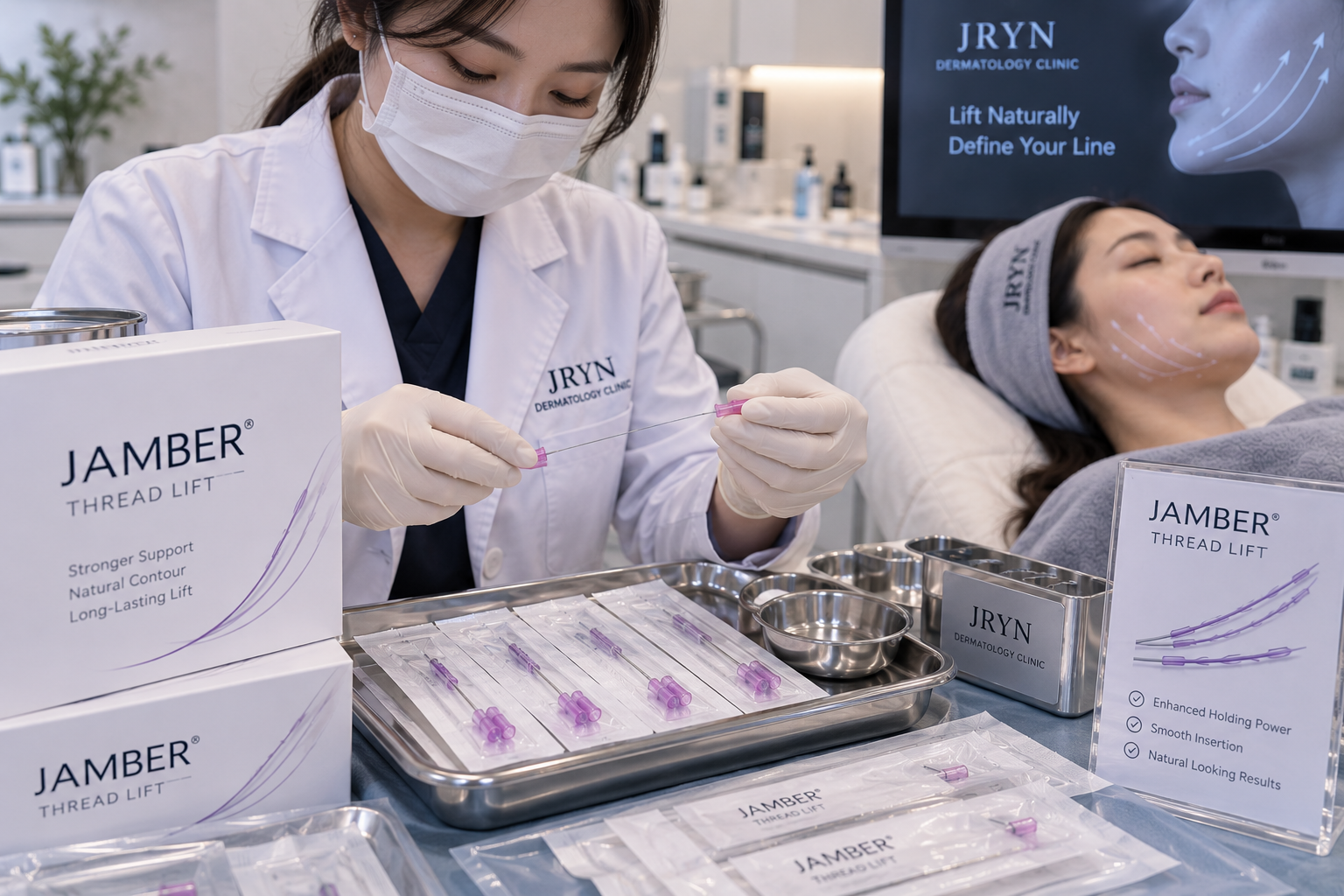
Jamber Thread Lift is a thread-based facial lifting approach where treatment planning focuses on the direction of tissue movement, the selected lifting vectors and the amount of support appropriate for each individual face.
When facial tissues gradually descend, simply adding volume may not address the change in facial contour. Thread lifting can be considered when selected tissues may benefit from mechanical support and repositioning.
At JRYN, Jamber treatment planning focuses on facial anatomy, tissue descent and the direction in which support is needed. Thread count and vectors are planned before placement rather than being decided casually during the procedure.
Jamber Thread Lift is used as part of a customized thread-lifting plan where placement, count and vectors are selected according to the patient's facial needs.
Thread lifting uses absorbable threads to provide mechanical support to selected facial tissues. The visible effect depends not only on the thread itself, but also on where it is placed, the direction of the vector and the amount of tissue being supported.
For this reason, a well-planned Jamber treatment should begin with an assessment of facial descent and contour. The objective is to create appropriate support without producing an overly pulled or unbalanced appearance.
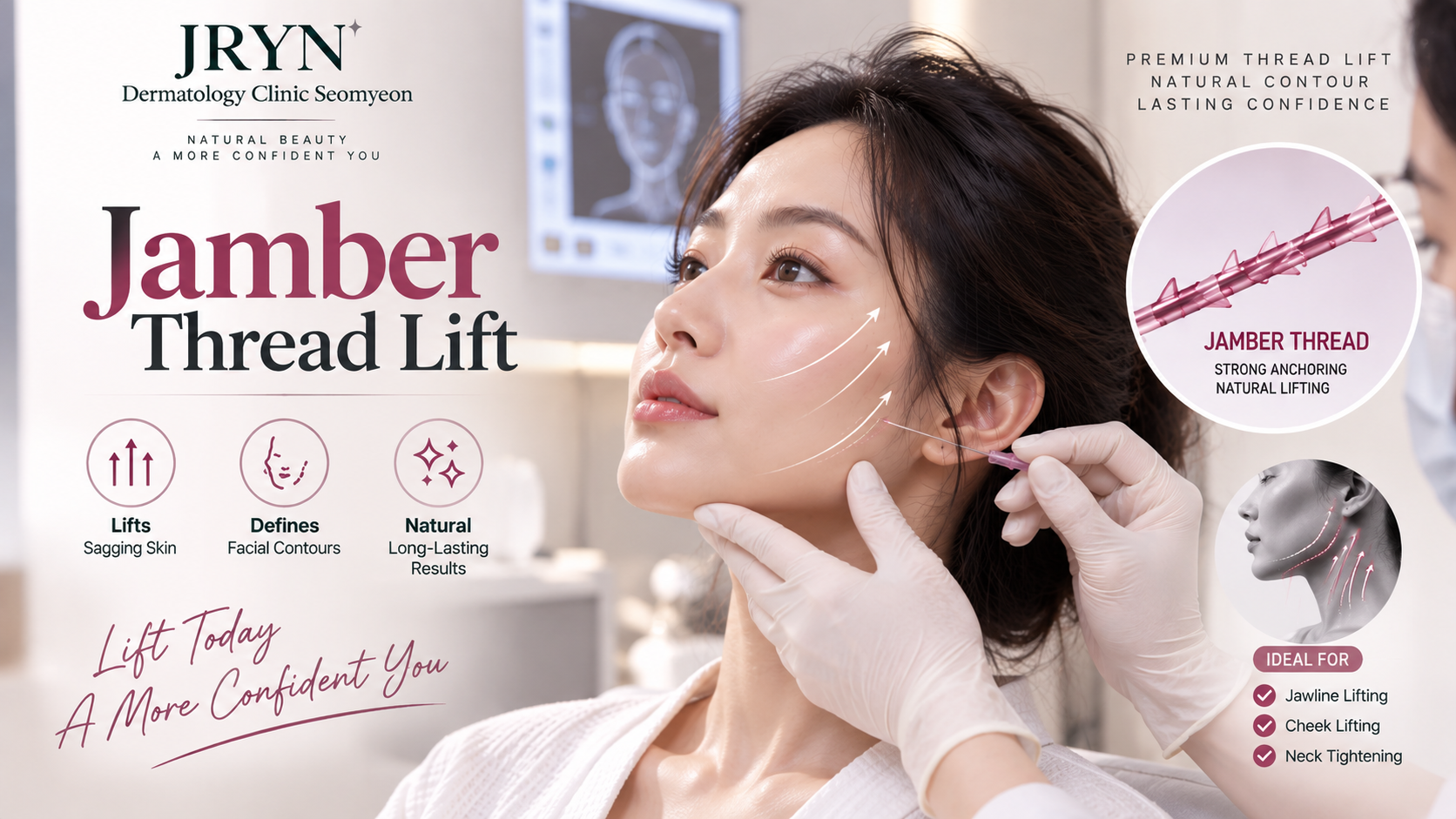
The direction of a thread influences the direction in which tissue is supported. Careful vector mapping helps the doctor determine how the treatment should follow the patient's existing facial structure rather than applying a single pattern to every face.
The lower facial outline has become less defined as elasticity and tissue position change.
Mild sagging has become noticeable and a non-surgical lifting option is being considered.
The cheek area appears heavier or lower as facial tissues gradually shift downward.
The lower face is beginning to lose definition around the jawline and jowl area.
You want lifting to be planned carefully to avoid an unnecessarily tight or over-corrected appearance.
You prefer thread count and lifting vectors to be decided according to your own facial structure.
The doctor evaluates facial structure, tissue descent, elasticity and the areas where support may be appropriate.
Lifting directions are mapped according to the patient's facial anatomy and desired contour.
The treatment area and appropriate number of threads are determined before placement.
Threads are placed according to the agreed plan and the treated contour is reviewed as recovery progresses.
Your doctor evaluates facial structure, tissue descent, elasticity and the concerns you want to address.
The intended lifting directions and treatment areas are mapped according to your facial anatomy.
The appropriate number of threads is determined according to the planned treatment and degree of support required.
Recovery and the developing contour can be reviewed as the treated tissues settle over time.
Jamber Thread Lift is a non-surgical facial lifting option that can be considered for selected concerns involving facial laxity, tissue descent and reduced contour definition. Thread lifting uses absorbable threads to provide support to carefully selected facial tissues.
At JRYN Seomyeon Dermatology Clinic, Jamber Thread Lift planning focuses on facial anatomy, tissue movement and the direction of support needed. Thread count and lifting vectors can be mapped before placement so that the treatment plan is clear before the procedure begins.
The appropriate number of threads varies according to the patient's facial structure, degree of descent and treatment objectives. A consultation is therefore important before deciding on the number of threads or the exact treatment areas.
The goal of Jamber Thread Lift is not simply to pull the face upward. A carefully planned treatment aims to improve support and facial definition while maintaining balanced, natural-looking proportions. Individual results, recovery and longevity vary from person to person.