01
★★★★★
“It was my first visit, and the staff were incredibly friendly. The clinic was clean, and the treatment was carried out with care and attention. I was very satisfied with the experience.”
Angela Park
Google Review
G
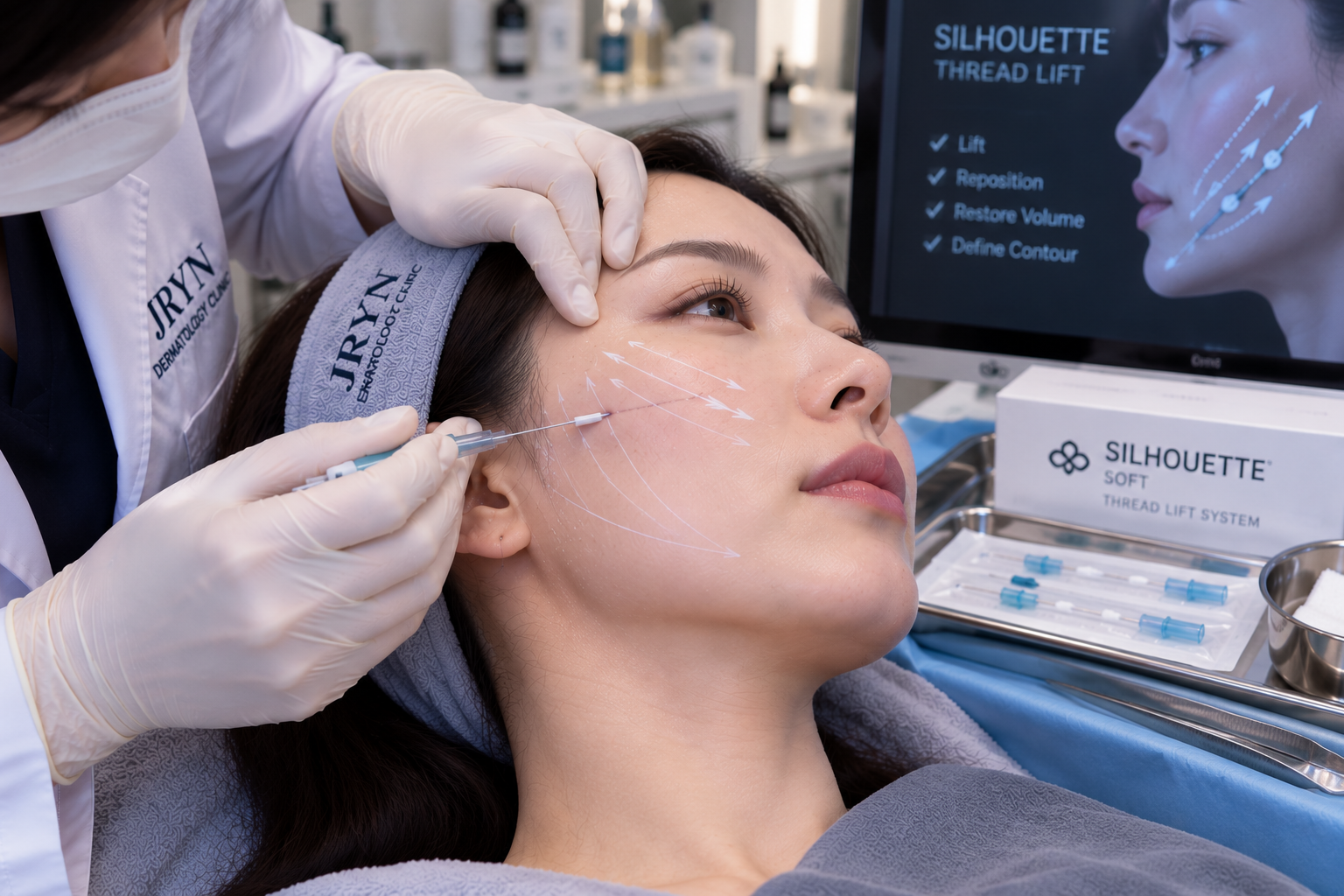
Silhouette Thread Lift is designed for visible facial repositioning while preserving a natural, balanced appearance. Treatment planning focuses on facial structure, tissue movement and carefully selected lifting vectors.
As facial tissues gradually descend, the mid-face can begin to look heavier and the lower facial contour may become less defined. Thread lifting can be considered when repositioning is more appropriate than simply restoring volume.
At JRYN, the treatment plan is based on facial structure, elasticity and the direction in which tissue needs to be supported. The goal is a refined change that remains consistent with your natural facial proportions.
Silhouette-style threads use absorbable sutures with bidirectional cones designed to engage tissue and support controlled repositioning.
Unlike conventional barbed threads that grip tissue along the surface of the thread, cone-based Silhouette threads are designed to engage surrounding tissue in multiple directions. This makes them particularly relevant when the treatment goal involves repositioning rather than simple surface tightening.
For patients with mid-face descent, cheek heaviness or a less defined lower facial outline, the treatment may be planned around upward-and-back vectors that follow the patient's existing anatomy.
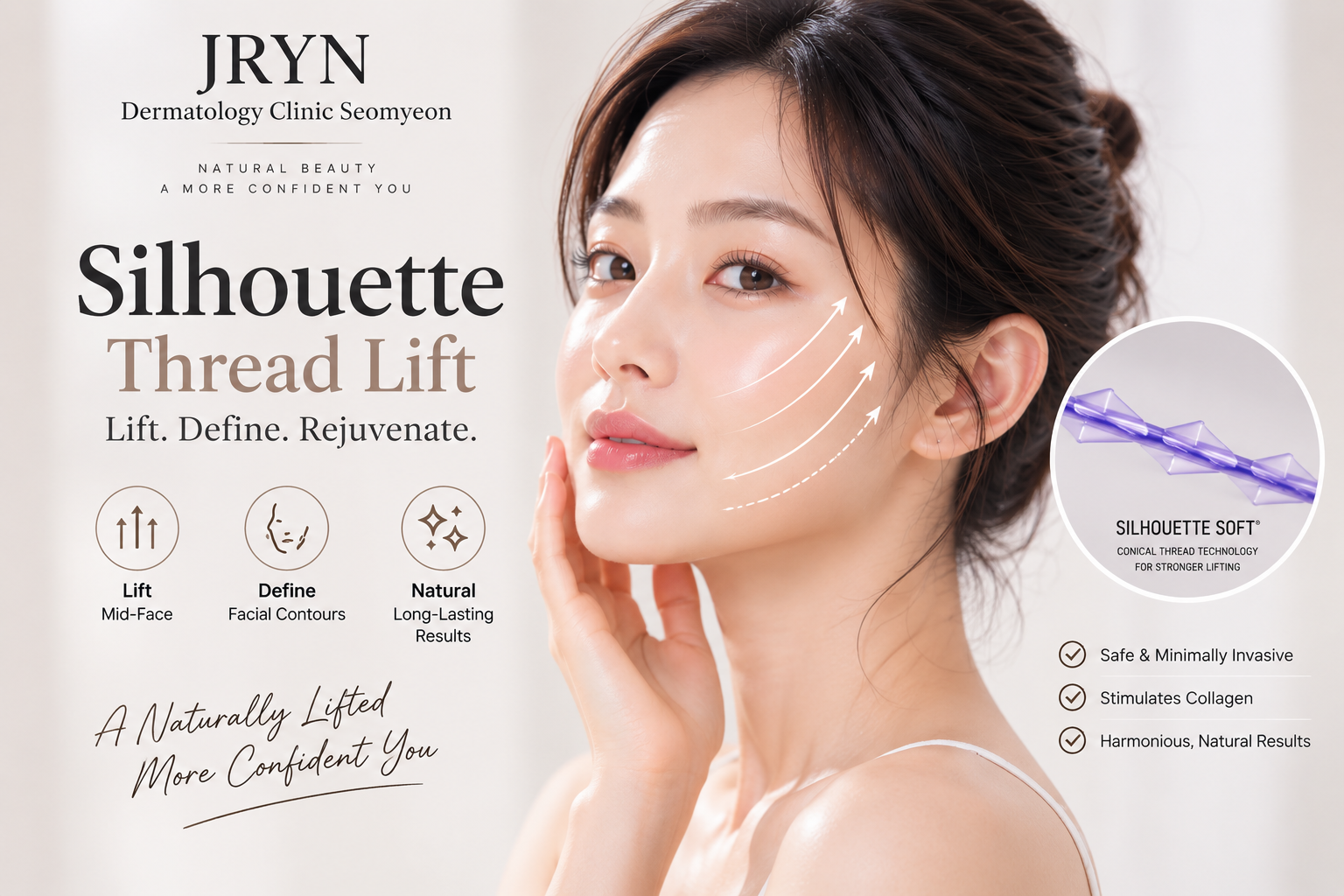
A carefully planned thread treatment considers where tissue has descended, where support should be restored and how the resulting contour fits the patient's overall facial balance. Rather than creating an exaggerated pull, the objective is controlled refinement.
The cheek area appears to have moved downward or forward, creating a heavier facial impression.
The transition from the cheek toward the jawline has become less clear as facial tissues gradually descend.
The lower face may appear fuller because of tissue movement, rather than because additional volume is needed.
Mild lower-face sagging may be related to changes beginning higher in the cheek and mid-face.
Patients who prefer subtle structural refinement rather than a visibly over-pulled appearance.
A consultation can determine whether repositioning, volume restoration or another lifting approach is more appropriate.
Facial proportions, elasticity, tissue descent and the areas requiring support are assessed before treatment planning.
Lifting directions are selected according to the patient's facial anatomy rather than using a single standard pattern.
Threads are positioned according to the planned vectors and the intended areas of tissue support.
The treatment is evaluated as part of the whole face, with emphasis on balanced and natural-looking refinement.
Your doctor evaluates facial structure, tissue movement, elasticity and the concerns you want to address.
The lifting direction and treatment areas are planned around your individual facial proportions.
The selected thread is placed according to the planned treatment strategy and target areas.
Recovery and the developing result can be reviewed as the treated tissues settle over time.
Silhouette Thread Lift is a non-surgical facial lifting option that can be considered when facial tissues have gradually descended and the patient wants more structural repositioning. The treatment uses absorbable threads with bidirectional cones designed to engage tissue and support selected lifting vectors.
At JRYN Seomyeon Dermatology Clinic, Silhouette Thread Lift planning is individualized according to facial anatomy, elasticity, tissue movement and the desired degree of refinement. Mid-face descent, cheek heaviness, early jowling and reduced facial definition may all be considered during assessment.
A consultation is important because thread lifting is not the right solution for every type of facial change. Depending on whether the primary concern is tissue descent, volume loss, skin laxity or another structural issue, a different treatment or combination approach may be more appropriate.
The goal is not simply to pull the face upward. A carefully planned treatment aims to restore support and improve facial balance while keeping the result consistent with the patient's natural appearance.